
From Role-Play to Real Results
How XR Builds Confidence for Tough Conversations
We’ve all been through awkward training role-plays.
They’re uncomfortable, unrealistic, and often feel like a waste of time.
The “pretend” customer or “acting” coworker can’t capture the emotions, pressure, or unpredictability of real life.
But what if you could practice tough conversations in a space that feels real, without real-world consequences, and actually walk away feeling confident?
That’s where XR simulations come in. Backed by research and built for realism, they replace awkward role-play with authentic, repeatable practice that sticks.

1. The Problem with Traditional Role-Play
In theory, role-plays are a great idea. In practice, they fall short.
Common challenges include:
- Low realism: It’s hard to act like an irate customer when you’re also a coworker.
- Awkwardness: Participants feel self-conscious, which limits genuine reactions.
- Inconsistent facilitation: Outcomes depend heavily on the facilitator’s skill, not the exercise itself.
When training doesn’t feel real, participants don’t take it seriously and they rarely gain the confidence to apply it under pressure.
2. Enter Real-Play
Real-Play is an advanced form of experiential learning that goes beyond the awkwardness of traditional role-play. Instead of asking participants to “pretend” in scripted scenarios, real-play uses human-controlled avatars in mixed reality environments to recreate authentic, real-world situations.
These avatars are operated by trained specialists who respond in real time, adjusting tone, body language, and dialogue to match the participant’s skill level. This creates deep emotional realism, boosts engagement, and helps learners reach their peak performance state in a safe, supportive environment.
Because the simulation can adapt instantly, participants get the right balance of challenge and support, encouraging continuous growth. Rooted in the 70-20-10 learning model, real-play emphasizes hands-on practice, peer learning, and real-world application, and it works whether the session is virtual, hybrid, or in person.

3. Confidence Comes From Realistic Repetition
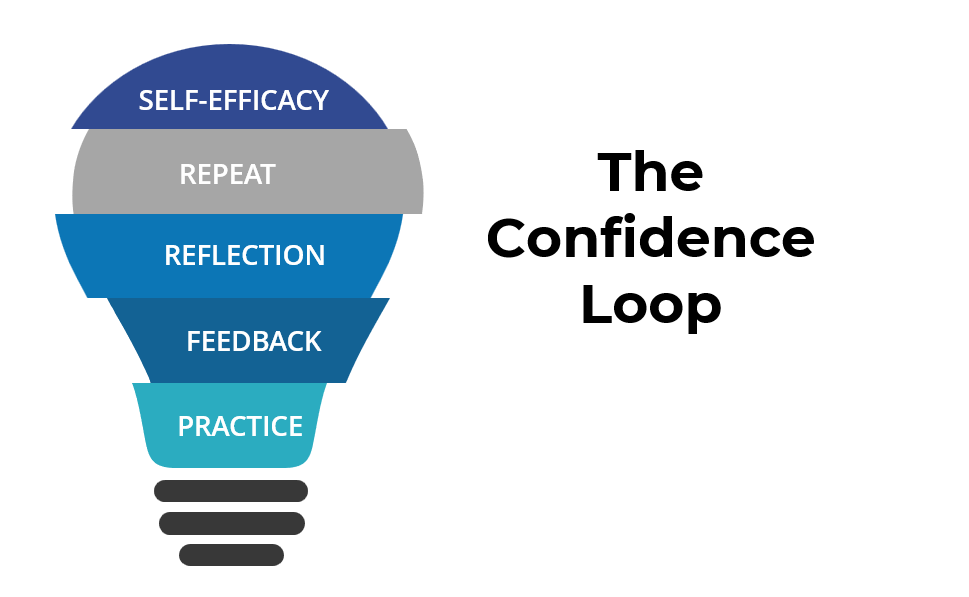
Research in multiple fields shows that self-efficacy, your belief in your ability to succeed, grows through realistic, repeated practice.
In other words, it’s not about trying a conversation once. It’s about practicing it until it becomes second nature. XR simulations make this possible without requiring the high cost (and high stakes) of live, real-world practice.
Improving negotiation skills with structured role-play simulations
Demonstrated that structured sales simulations significantly improved participants’ negotiation confidence and closing performance over time.
Enhancing students’ self-confidence with repeated virtual simulations
Found that social work students who engaged in virtual simulations and scripted role plays reported significant gains in self confidence and readiness for real client interactions.
4. Case Examples from XR Simulations
Adam Rivera Feedback Conversation
A trainee must give constructive feedback to Adam, a seasoned operations analyst who missed a deadline due to vague instructions and unresponsive departments. Adam reacts defensively at first, then softens as the trainee clarifies expectations, a chance to practice empathy and coaching.
Hostile Driver First Responder Scenario
A first responder approaches a minor traffic accident. The driver becomes verbally aggressive, questioning the responder’s competence. The trainee must de-escalate the situation while maintaining authority and safety.
Sales Objection Handling
A long-term client considers a competitor’s lower-priced offer. The trainee practices overcoming price objections by reinforcing value and ROI, informed by data and trust-building.
These scenarios feel real because they’re emotionally responsive, the avatars’ tone, body language, and expressions change based on what the trainee says.
In the real world, theory alone is like having a map but no practice driving the roads. When we combine evidence-based design, authentic scenarios, and guided reflection, people don’t just know what to do, they can do it under pressure.
5. Why Emotional Realism Matters
It’s one thing to recite the “right” words in a scripted role-play. It’s another to say them while someone looks frustrated, skeptical, or even hurt.
- Emotional realism triggers the same physiological and cognitive responses as real life.
- Avatars in XR simulations can show microexpressions, the flicker of doubt, the narrowing of eyes, that human role-players often can’t replicate consistently.
6. From Practice to Performance
XR simulations turn tough conversations into safe, repeatable practice, so by the time you face them in the real world, you’re ready. The emotional realism, adaptability, and guided feedback mean every round makes you better.
- Communication clarity improves because trainees have practiced making their point under pressure.
- Active listening sharpens as participants learn to read both verbal and nonverbal cues.
- Emotional regulation strengthens because they’ve experienced and adapted to realistic emotional triggers.